The Token Launch PR Playbook: What to Do at Each Phase
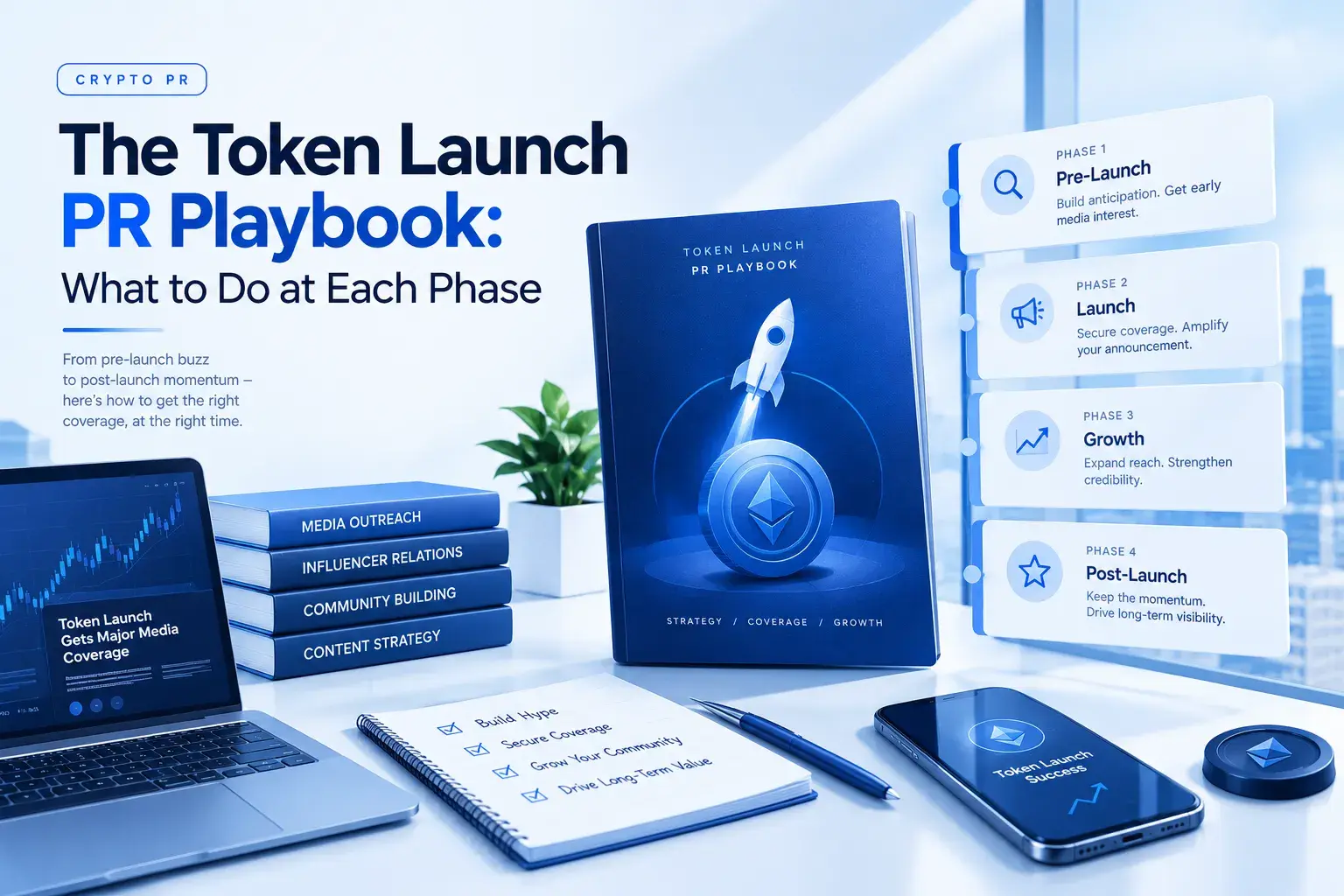
Most token launch PR fails on sequencing, not on media relationships. A founder briefs an agency too late, skips the internal work that makes a pitch credible, or stops paying attention the day the token lists, when the second half of the story is still being written. This guide sets out what actually happens at each phase of a token launch, in order, and what a founder personally is responsible for at each stage. It is written for a founder or comms lead who has already decided they need launch PR and now needs to know what the work actually looks like.
What Is the Token Launch PR Timeline?
A token launch runs across four phases, each with distinct deliverables and distinct risks. The table below sets out what each phase covers.
This table is the fastest way to check where a launch actually sits against where it should sit. If a launch is six weeks out and phase one items are still unresolved, the launch is behind schedule regardless of what the calendar says.
Phase One: Foundation (Weeks 12 to 8)
Foundation work happens before an agency pitches a single journalist. It is not optional groundwork. It is the material that turns a press release into a story a journalist actually wants to write.
A defined narrative thesis. What does this token actually do, in one sentence that does not rely on category buzzwords. A narrative thesis answers why this project exists, why now, and why it is different from the last twenty tokens that used similar language. If the internal team cannot agree on this sentence, no agency briefing will produce one on their behalf.
A spokesperson with confirmed availability. Journalists want to speak to a named person, not a communications team. Confirm who that person is, confirm they are prepared to be quoted and interviewed, and confirm their calendar has room for briefings across the following eight weeks, including the launch week itself.
Approved claims and non-claims. Write down, explicitly, what the project will say publicly and what it will not. This includes performance claims, partnership claims, and anything that implies price expectations. Getting this agreed internally before external conversations start prevents a spokesperson improvising an answer under journalist pressure that the legal or compliance function would not have approved.
A data story. Journalists write stories from numbers, not adjectives. This might be a testnet metric, a waitlist figure, a partnership commitment, or a comparison point against a named competitor category. Whatever it is, it needs to be specific and independently checkable, not a rounded, unverifiable statistic offered without a source.
Competitive positioning. A clear, honest statement of what makes this project different from adjacent projects a journalist will inevitably compare it to. This is not marketing copy. It is the answer a spokesperson gives when a sceptical journalist asks "how is this different from the ten other projects doing something similar."
An agency briefed without these five things produces a press release. An agency briefed with them produces coverage, because the material given to a journalist actually answers the questions a journalist is trained to ask. This distinction, more than any single relationship or media list, is what separates a launch that lands from one that does not.
Phase Two: Pre-TGE Narrative Building (Weeks 8 to 4)
This phase is where the narrative built in phase one gets tested against real journalists, under real scrutiny, before the announcement is public.
Analyst and journalist briefings under NDA. Selected journalists and industry analysts are briefed on the project ahead of the public announcement, under a non-disclosure agreement that allows them to prepare informed coverage without publishing early. This is distinct from an embargo, which covers publication timing rather than pre-publication access. An NDA briefing lets a journalist ask hard questions, test the narrative and begin drafting a considered piece, rather than receiving the finished press release cold on announcement day.
Deciding between an exclusive and an embargo. An exclusive gives one outlet first and sole access to the story, in exchange for that outlet's commitment to run a substantial piece rather than a short news item. An embargo gives multiple outlets simultaneous advance access, all releasing at an agreed moment, producing a wider spread of coverage on the same day. Exclusives work when a single tier-one outlet's depth matters more than breadth. Embargoes work when a coordinated wave across many outlets matters more than any single outlet's depth. Most token launches use an embargo, reserving an exclusive only when a specific outlet's angle is worth trading breadth for.
Building the media list by beat, not by publication. A generic list of "crypto journalists" is less useful than a list organised by beat: which named journalist at which outlet covers exchange listings specifically, which covers DeFi infrastructure, which covers regulatory developments. A pitch that matches the right beat to the right journalist gets a materially higher response rate than a mass distribution to a generic list.
Thought leadership that establishes the founder before the announcement. Bylined articles, podcast appearances and conference commentary in the weeks before a TGE build a public track record for the spokesperson, so that by the time the launch is announced, the founder is already a known, credible voice rather than an unfamiliar name attached to a new token. This groundwork materially increases the odds that launch-day coverage takes the founder's framing seriously rather than treating the project as one of many indistinguishable launches that week.
What to hold back. Not every detail belongs in the pre-TGE briefing. Final tokenomics figures, the exact TGE date and time, and any material partnership announcement should typically be held for the launch window itself, so that the announcement retains genuine news value rather than becoming old information by the time it is formally released.
By the end of this phase, the narrative has been tested against real journalist scepticism, the media list is built and beat-mapped, and the founder has a public track record that predates the launch announcement.
What Goes in a Token Launch Media Kit?
A finalised media kit should exist at least two weeks before the TGE. It typically contains eight items.
Press release. The core announcement document, written to answer who, what, why now and why it matters, without relying on the reader already understanding the project.
Fact sheet. A one-page document with the essential, independently checkable facts: what the project does, key dates, key figures, and links to primary sources.
Tokenomics one-pager. Supply, distribution, vesting schedule and utility, presented clearly enough that a journalist unfamiliar with the project's specific model can understand it without a follow-up call.
Founder bios and headshots. Professional, current, and consistent across every outlet a journalist might check to verify who they are speaking to.
Brand assets. Logo files, product screenshots and any diagram that helps a journalist illustrate the story without needing to request assets under deadline pressure.
A Q&A covering the hard questions. Not a sanitised FAQ. The genuinely difficult questions a sceptical journalist is likely to ask, answered honestly and consistently, so the spokesperson is not improvising a first answer to a hard question live.
Spokesperson availability windows. Specific times the founder or spokesperson is available for interview requests around the announcement, so a journalist working to a tight deadline knows whether a same-day interview is realistic.
An embargo statement. A clear, written statement of the embargo terms given to every journalist receiving the kit under embargo, removing any ambiguity about when the story can run.
Journalists working under deadline pressure open the fact sheet and the Q&A first. The press release is often skimmed rather than read closely, because a busy journalist is looking for the specific facts and the hard-question answers, not the narrative framing, which they intend to write in their own words regardless.
How Do Crypto Press Embargoes Work?
An embargo is an agreement: a journalist receives information ahead of publication in exchange for holding the story until an agreed date and time. It is not a guarantee, a contract in the legal sense, or a mechanism that can be enforced after the fact. It works because most journalists value ongoing access to a source more than the marginal advantage of breaking one story early.
Setting the time across time zones. An embargo lift time should be specified in a single reference time zone, stated explicitly, with the corresponding local time confirmed for every journalist on the list. A launch spanning outlets in the UK, the US and Asia needs the lift time to land at a publishable hour in each region, or several outlets will effectively be locked out of same-day coverage regardless of the embargo terms.
Deciding who gets an exclusive and what is given up in exchange. Offering an exclusive to one outlet means every other outlet on the list waits until that outlet has published, or receives the story only after the exclusive window closes. The trade is depth for breadth: one outlet gets a substantial piece with unique access, while every other outlet's coverage is delayed or diminished. This decision should be made deliberately, not as a default, because it directly determines how wide the day-one coverage spread will be.
What happens when one outlet breaks the embargo. If an outlet publishes before the agreed time, every other journalist on the embargo list learns about it immediately, usually from the same monitoring tools journalists use to track competitors. The practical response is to lift the embargo for everyone else immediately rather than trying to hold a broken line, and to have a clear internal decision-maker ready to make that call within minutes, not hours. A broken embargo fragments the coordinated narrative: some coverage reflects the intended framing, other coverage is a rushed reaction to another outlet's early piece, and the story loses the coordinated wave that made the embargo worth setting in the first place.
Why embargo discipline is the clearest signal of agency or team quality. Anyone can draft a press release. Coordinating a simultaneous, multi-outlet release under embargo, across time zones, with a Plan B ready if something breaks, requires a genuine operational process built before the risk materialises. A team that cannot describe, in specific terms, what happens if an outlet breaks embargo has not run this process before.
What Does the TGE-Day Runbook Look Like?
TGE day runs on a fixed sequence, hour by hour from the moment the embargo lifts.
At embargo lift. Every outlet on the embargo list publishes simultaneously, or as close to simultaneously as each outlet's own publishing process allows. This is the moment the coordinated work of the previous eight weeks either lands as intended or does not.
In the following hour. Monitoring begins immediately: tracking which outlets have published, whether the coverage reflects the agreed narrative, and whether any factual error needs a fast correction request to the outlet. This is also when owned channels begin their amplification sequence: the project's own social accounts, newsletter, and community channels share the coverage as it appears, rather than waiting for a single end-of-day roundup.
Through the day. A defined community messaging window keeps the project's own channels aligned with the press narrative, so a community member reading the press coverage and a community member reading the project's Discord or Telegram see a consistent story rather than two disconnected accounts of the same event.
Throughout the day, one person is authorised to respond to press questions. Not the whole team, not whoever is online at the time. A single named spokesperson, with a clear escalation path if a question falls outside what they are authorised to answer, so that inconsistent answers from multiple team members do not undermine the coordinated story mid-day.
The escalation path. If something breaks during the TGE itself, a technical issue, a delayed listing, or a factual dispute with a journalist, there needs to be a named decision-maker who can be reached within minutes, with the authority to pause outreach, issue a correction, or adjust the day's plan. Building this path the week before launch, rather than improvising it under pressure, is what separates a controlled response from a visible scramble.
What Happens to PR After the Token Lists?
The fortnight after listing is the phase most campaigns skip, and it is the most expensive mistake in the entire process. Coverage and community attention spike on TGE day and decay quickly if nothing sustains them, and the roughly fourteen days that follow are still an open narrative window, not a wind-down period.
Second-wave coverage. Once the initial announcement cycle has run its course, follow-on interviews and deeper feature pieces become possible, often with outlets that did not run day-one coverage but pick up the story once early data exists to report on.
Trader and analyst-facing outlets. Once the token is trading, a different set of publications becomes relevant: those covering market activity, liquidity and early trading patterns, distinct from the launch-announcement outlets that covered the pre-listing story.
Post-listing thought leadership. Bylined commentary and interviews continue in this window, now informed by real trading data and early usage metrics rather than pre-launch projections, giving the founder genuinely new material to discuss rather than repeating the launch pitch.
Syndication and distribution of the original coverage. The launch-day placements do not stop generating value once published. Syndicating that coverage through owned channels, newsletter partners and content distribution extends its reach well beyond the outlet's native readership on the day it ran.
A project that treats TGE day as the finish line cedes the narrative at exactly the moment competitors, critics and speculative commentary start filling the resulting silence. The fourteen-day window exists whether or not a project uses it. Regulatory considerations also intensify here: once a token is tradeable, language that was acceptable pre-launch can constitute a regulated financial promotion in some jurisdictions. In the UK, this falls under the Financial Conduct Authority's financial promotions regime; in the UAE, under the Virtual Assets Regulatory Authority framework. Messaging used in this window should be reviewed market by market before publication. This is a communications consideration, not legal advice, and projects should take their own legal counsel on what can be said in each jurisdiction once a token is live.
What Does a Founder Personally Have to Do?
This checklist belongs to the founder, not the comms team. Each item is tied to the week it typically falls in.
Week 12: Agree the narrative thesis internally, in one sentence, before any external conversation happens.
Week 11: Confirm spokesperson availability for the full twelve-week window, including launch week itself.
Week 10: Sign off the approved claims and non-claims document, including a review with legal or compliance if the project has that function.
Week 8: Begin analyst and journalist briefings under NDA, personally taking the calls where a named spokesperson is expected.
Week 6: Start thought leadership activity, submitting bylined commentary or accepting interview requests under the founder's own name.
Week 2: Review and approve the final media kit, including the Q&A document covering the hard questions.
Week 1: Confirm availability for TGE day itself, including the specific hours around the embargo lift.
Week 0 onward: Stay available for follow-on interviews through the fourteen-day post-listing window, not only on launch day.
Missing any one of these items does not necessarily break the launch, but each one that slips pushes risk downstream into a phase with less time to recover from it.
What Goes Wrong in Token Launch PR?
1. Briefing an agency before the narrative exists. The team engages PR support before agreeing internally what the project's narrative thesis actually is. The early signal: a kickoff call where the team cannot answer, in one sentence, why the project exists and why now.
2. Embargo break. An outlet publishes before the agreed time, fragmenting the coordinated release. The early signal: an embargo list assembled without individually confirmed agreement from each journalist, rather than one built through direct, confirmed outreach.
3. Agency or team capacity collision with another launch. Attention meant for this TGE is split because the same people are managing another client's or project's launch in the same window. The early signal: no named individual has confirmed, in writing, that this launch has their full attention during launch week specifically.
4. Coverage landing a day late. Stories run after the TGE, once the market has already formed its own view from on-chain activity and social commentary. The early signal: journalist commitments and publication slots have not been confirmed at least a week before the embargo date.
5. No post-listing plan. All activity was scoped to end at TGE day, and the project loses the narrative in the silence that follows. The early signal: the plan describes launch day in detail and says nothing about the two weeks after it.
6. Regulatory language problems once the token is tradeable. Pre-launch messaging about future utility or expected growth continues unchanged into post-listing communications, where the same language now describes a live, tradeable asset and carries different regulatory exposure under regimes such as the UK's financial promotions rules or VARA in the UAE. The early signal: no one has reviewed the messaging plan specifically for the shift from pre-launch to post-listing language, market by market. This is a communications flag, not a legal judgement, and any live concern should go to qualified legal counsel before publication.
Closing: Sequencing Is the Work
The single principle running through every phase in this guide is that token launch PR is sequential, not simultaneous. Foundation work has to exist before narrative briefings can be credible. Narrative briefings have to happen before the media kit is finalised. The media kit has to be finished before embargo terms are set. And the work does not end at TGE day: the fourteen days that follow are still an open window, not a wind-down. Get the order right, and coverage tends to follow. Get it out of order, and no relationship or media list fully compensates for it.
GeniusPR (formerly The PR Genius), a crypto, Web3 and AI PR agency with offices in London, Dubai, Newark DE and Seoul, runs this exact phase structure as a dedicated token launch PR service. Readers deciding which agency to brief for a launch, rather than what to do once one is engaged, may find the companion comparison useful: Best Crypto PR Agencies in 2026: A Buyer's Evaluation Guide. Published campaign results are available in its case studies.
Frequently Asked Questions
How do you PR a token launch?
Token launch PR runs in four phases: foundation work to agree the narrative and approved claims, pre-TGE briefings with journalists and analysts under NDA, a launch window built around a finalised media kit and embargo coordination, and a post-listing period sustaining coverage for roughly fourteen days after the token trades. Each phase depends on the one before it being genuinely complete, not just scheduled.
When should I start PR before a TGE?
Foundation work should begin around twelve weeks before the TGE, covering the narrative thesis, spokesperson confirmation and approved claims. Journalist and analyst briefings typically start around eight weeks out. Starting later compresses these steps and produces reactive, rushed coverage rather than a considered, well-briefed launch.
What goes in a token launch media kit?
A finalised media kit contains a press release, a fact sheet, a tokenomics one-pager, founder bios and headshots, brand assets, a Q&A covering the hard questions, spokesperson availability windows, and a written embargo statement. It should be finalised at least two weeks before the TGE, not assembled during launch week itself.
How do crypto press embargoes work?
An embargo is an agreement that a journalist will hold a story until an agreed date and time in exchange for advance access. It requires a specific lift time stated in one reference time zone, confirmed individually with every journalist on the list, and a clear plan for what happens if one outlet publishes early.
Should I give an outlet an exclusive on my token launch?
An exclusive trades breadth for depth: one outlet gets sole early access in exchange for a substantial piece, while every other outlet's coverage is delayed. This works when one tier-one outlet's depth matters more than a wide same-day spread. Most token launches use a multi-outlet embargo instead, reserving an exclusive for a specific strategic reason.
What happens if an outlet breaks the embargo?
Every other journalist on the embargo list typically learns immediately through their own monitoring tools. The standard response is to lift the embargo for everyone else at once rather than trying to hold a broken line, with a named decision-maker ready to make that call within minutes.
How do I announce a CEX listing?
A CEX listing announcement is coordinated with the exchange's own communications timeline, since exchanges frequently set their own embargo requirements around listing announcements. Pre-listing narrative work with institutional and community media, announcement-day coverage timed to the listing moment, and post-listing coverage using early trading data are the three stages typically involved.
What should I do on TGE day?
TGE day runs on a fixed sequence from embargo lift: simultaneous publication across the outlet list, immediate monitoring, amplification through owned channels, a defined community messaging window, one named spokesperson authorised to respond to press questions, and a clear escalation path if something breaks during the day.
How long does token launch PR take to prepare?
Most of the operational work described in this guide runs across a twelve-week window: foundation work in the earliest four weeks, narrative briefings in the following four, and the finalised media kit and embargo coordination in the final four weeks before the TGE. Compressing this into two or three weeks removes the time needed to build a credible, well-tested narrative.
What happens to PR after the token lists?
Coverage and community attention spike on TGE day and decay quickly without a sustained plan. The roughly fourteen days after listing remain an open narrative window for second-wave coverage, trader and analyst-facing placements, post-listing thought leadership and syndication of the original coverage. Treating TGE day as the end of the engagement is a commonly cited mistake.

book a meeting
Ready to kickstart your brand’s authority?
Please fill out the calender on our
website and we will do a meeting on your desired time.
SCHEDULE A CALL
At GeniusPR, we turn signals into stories and stories into systems that move markets.